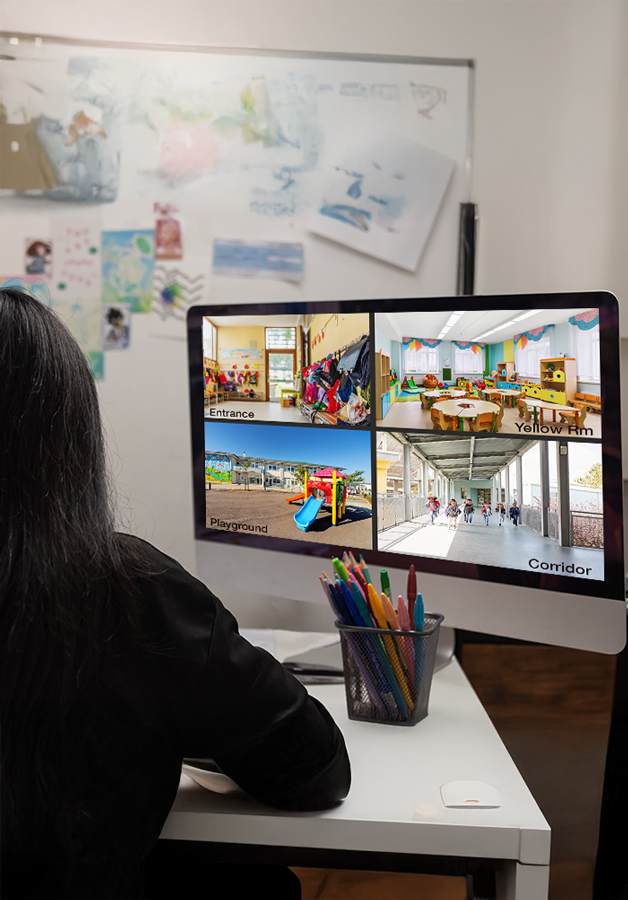
For most commercial nursery settings, the best CCTV solution is a professionally designed wired IP system that provides reliable high-definition coverage, secure recording and tightly controlled access to footage.
The system should be designed around the nursery layout and safeguarding risks, with cameras positioned only where there is a clear and justified purpose.
Features such as PoE connectivity, secure NVR recording, user permissions, audit trails, strong image quality and appropriate data security can make the system easier to manage and more dependable than a consumer Wi-Fi camera setup.
The right solution should support safeguarding and incident review while respecting the privacy of children, staff and visitors. CCTV should sit within a wider safeguarding policy, not replace it.
A nursery isn’t a warehouse, shop or office. CCTV may capture children throughout the day alongside employees, parents, contractors and visitors.
This means CCTV systems must be carefully planned, implemented and managed.
A professionally designed nursery CCTV system can support safeguarding by helping nursery leaders:
However, CCTV should not be treated as a substitute for appropriate staffing, supervision, safeguarding procedures or risk assessments.
Ofsted confirms that early-years providers may choose to use CCTV, but providers themselves must decide whether its use is appropriate and ensure it is operated in line with relevant data-protection and human-rights legislation.
That makes safeguarding, privacy and data protection central to how a nursery CCTV system is designed and operated.
Best for: Most commercial nurseries
IP cameras transmit digital video over a network. When connected using Power over Ethernet (PoE), a single network cable can provide both data connectivity and power.
Benefits can include:
For most professionally managed nursery environments, this would be our starting point.
Best for: Some existing installations
An existing analogue system doesn’t necessarily need replacing simply because newer IP technology exists.
Where cabling and cameras remain suitable, upgrading parts of an existing installation may sometimes be appropriate.
However, a nursery planning a completely new CCTV installation would generally benefit from considering an IP-based system.
Best for: Limited specialist applications rather than the default commercial installation
Consumer wireless cameras can be quick and easy to install, but they may not provide the same level of reliability, security, recording resilience and user control as a professionally designed commercial CCTV system. Many depend on a stable Wi-Fi or internet connection, may use cloud-based storage and can offer more limited control over user permissions, audit trails and system configuration. In a nursery environment, where footage may involve children, staff and visitors, these considerations are particularly important.
Consider:
There’s little value in recording an incident if the footage isn’t clear enough to understand what happened.
Resolution needs to be appropriate for the purpose and location of each camera.
Consider whether you need to:
Higher resolution isn’t automatically better if it creates unnecessary storage and bandwidth demands. The specification should match the purpose.
Power over Ethernet (PoE) allows compatible IP cameras to receive power and data through the same Ethernet connection.
For nurseries, this can help create a more structured wired installation without relying on each camera maintaining a Wi-Fi connection.
It can also make central management and maintenance easier.
An NVR (Network Video Recorder) provides centralised recording for IP cameras.
The NVR should be appropriately secured and located somewhere with controlled physical access.
When specifying storage, consider:
Number of cameras × resolution × frame rate × recording method × required retention period.
Rather than simply buying the largest hard drive available, storage should be designed around the nursery’s documented requirements.
Not everybody working in a nursery should automatically have access to CCTV footage.
A suitable commercial system should allow access to be restricted according to role.
For example:
Administrator
System configuration.
Nursery manager
Authorised viewing and incident review.
Other authorised users
Only the functions genuinely required for their role.
The principle should be:
Only the right people should have access to the right footage for the right reason.
Any nursery CCTV system should log who accessed footage and when. Any footage download should be recorded in a separate log as part of your wider CCTV policy.
Where supported by the system, audit logs can help nursery management understand:
This creates additional accountability around footage containing personal data.
Remote access can be useful for authorised managers, particularly across multi-site nursery groups.
But convenience shouldn’t come at the expense of security.
Remote access should therefore be appropriately configured and protected through measures such as strong authentication and restricted user access.
Privacy masking can block defined portions of the image from view or recording where needed.
A camera may need to cover an entrance or external area while avoiding unnecessary recording of neighbouring properties or other public areas.
Managers may want a camera in a baby changing area but want to mask the actual changing mats.
This supports the principle that CCTV coverage should be necessary and proportionate to its stated purpose. The ICO specifically emphasises necessity, proportionality, transparency and data protection by design when organisations deploy surveillance.
Nursery CCTV isn’t useful if a camera failed three weeks before an incident and nobody noticed.
Consider choosing a security partner that includes:

| Nursery area | What to consider |
| Entrance / Exit |
Clear images of people entering and leaving |
| Reception | Appropriate coverage without unnecessarily capturing private information |
| Playrooms | Wide coverage with careful positioning to minimise blind spots |
| Corridors | Discreet cameras providing useful circulation coverage |
| Outdoor play areas |
Weather-resistant cameras and appropriate field of view |
| Car parks | Cameras designed for external conditions and changing light |
| Perimeter | Detection and deterrence appropriate to the security risk |
| Sensitive/ privateareas |
Carefully assess whether CCTV is appropriate at all |
| Camera | Often useful for | Why |
| Dome | Indoor communal areas | Discreet appearance and protected camera housing |
| Turret | Indoor/general coverage | Flexible positioning and strong image performance |
| Bullet | External areas/perimeters | Visible deterrent and directional coverage |
| PTZ | Larger areas with a genuine operational requirement | Remote pan, tilt and zoom capability |
There isn’t one “best nursery camera”. A well-designed CCTV system may use several camera types because an entrance, playroom and outdoor perimeter each have different requirements.
There is no universal CCTV retention period that applies to every nursery. The ICO states that the UK GDPR and Data Protection Act 2018 do not prescribe a specific minimum or maximum retention period for CCTV footage. Instead, nurseries should keep footage for the shortest period necessary for the purpose for which it was recorded, document that period within their CCTV policy and securely delete footage when it is no longer required.
Most commercial CCTV systems can be configured to automatically overwrite older footage once the agreed retention period has been reached. The retention period should be based on the nursery’s requirements and purpose for using CCTV – not simply on how much storage capacity is available.
If an accident, safeguarding concern, security incident or other event occurs, an authorised user can locate the relevant recording and export or download a copy from the CCTV system so that it is preserved before the system’s normal overwrite process removes it.
A commercial CCTV system should allow footage to be exported in a suitable format without unnecessarily reducing image quality or losing important information such as the recording’s time and date. The ICO specifically identifies the ability to obtain copies in a timely manner, without losing image quality or time-and-date information, as an important consideration when operating surveillance systems.
Once footage has been downloaded, it should continue to be treated as personal data and managed securely. Nurseries should:
The ICO recognises that footage may sometimes need to be retained beyond the normal retention period for a specific purpose, such as an active investigation. However, this does not mean downloaded footage should be kept indefinitely. The nursery should be able to justify why it is still required and securely delete it when that purpose ends.
The key principle is simple: whether footage remains on the CCTV recorder or has been downloaded following an incident, it must be securely controlled, retained for a justified period and deleted when it is no longer needed.
CCTV footage that identifies individuals constitutes personal data, meaning organisations using CCTV need to consider their responsibilities under UK GDPR and the Data Protection Act 2018.
Before installing or substantially changing a nursery CCTV system, consider:
The ICO specifically advises organisations to consider data protection before purchasing a surveillance system, rather than selecting technology simply because it is available or affordable.
Read the ICO’s guidance on video surveillance and CCTV →
Before choosing your system, ask:
A CCTV system is only as effective as its design.
Two nurseries with the same number of rooms may require completely different systems because entrances, outdoor areas, lighting, building construction, network infrastructure and safeguarding requirements differ.
A professional CCTV survey should therefore start with the purpose of the system and the risks it needs to address before deciding how many cameras are required.
An Almas nursery CCTV survey will assess:
Not sure what CCTV system your nursery needs?

For a permanent commercial installation, wired IP cameras using PoE can provide greater connection reliability and centralised management than cameras dependent on Wi-Fi. However, the appropriate technology should be determined by the building, infrastructure and requirements.
There isn't one resolution appropriate for every camera. Image quality should be sufficient for the purpose of that camera—for example, identifying someone at an entrance may require different detail from monitoring activity across a large external area.
Potential areas include entrances, exits, reception areas, corridors, communal spaces, outdoor play areas and external perimeters. Each camera should have a defined purpose and its positioning should avoid unnecessary or disproportionate recording.
Ofsted states that early-years providers may choose to use CCTV, but providers need to decide whether arrangements are appropriate and comply with relevant legislation. Camera placement should therefore be assessed carefully rather than assuming every room should be monitored.
There is no single retention period appropriate to every nursery. Footage should not simply be retained indefinitely; the nursery should establish and document a retention period appropriate to the purpose for which the footage is processed.
Access should be restricted to authorised people who genuinely require it. A commercial CCTV system can support this through individual accounts, permissions and, where available, audit trails.
Where CCTV captures identifiable individuals, the organisation processing that footage needs to comply with applicable data-protection requirements including UK GDPR and the Data Protection Act 2018.
Some systems technically allow remote access, but providing live access to parents raises additional privacy, security and safeguarding considerations. Nurseries should assess these carefully and seek appropriate data-protection advice before introducing such access.
CCTV can support safeguarding by providing recorded evidence and helping settings review incidents, but it should complement, not replace, appropriate staffing, supervision, safeguarding policies and procedures. The EYFS places wider safeguarding and welfare responsibilities on early-years providers.
How does CCTV support safeguarding in a nursery?
What type of CCTV system is best for a nursery?
The 8 features we recommend considering for nursery CCTV
Which CCTV camera is best for each nursery location?
What different types of CCTV camera can be used in nurseries?
How long should a nursery keep CCTV footage?
Nursery CCTV and GDPR – what should you consider?
A simple nursery CCTV specification checklist
Why professional CCTV design matters in a nursery