
New Guide: Protect Your Business from Payroll Leakage & Legal Risk in 2026

Updated for 2026: Why Nursery Electronic Door Access Control Is Now A Vital Component of Security and Safeguarding
Safeguarding expectations in early years’ settings continue to evolve. In 2026, Nursery Electronic Door Access Control (EDAC) is no longer viewed as a “nice to have”, it is increasingly considered a baseline requirement for responsible nursery management.
Recent national safeguarding incidents, heightened Ofsted scrutiny and growing parent awareness mean that nursery owners must demonstrate not just policies, but visible, robust site security measures.
Traditional keys and keypad codes rely heavily on memory and human behaviour. But safeguarding in early years environments must not depend on goodwill alone.
Electronic door access control removes ambiguity by:
For nursery leaders balancing compliance, reputation and operational pressure, electronic access control provides something increasingly valuable: certainty.
In July 2023, a scary incident in Stone, Staffordshire, UK, sent shockwaves through the community. A three-year-old boy managed to escape from a local Nursery and crossed a busy A520 road undetected. The child had passed through a broken fence at the nursery, and CCTV footage later revealed the danger he had been in. CCTV footage from the town centre showed the toddler running through the village before pausing on a pedestrian crossing, eventually crossing the road safely.
Ofsted inspectors visited the nursery, highlighting the need for improved security and staffing to ensure child safety, which had been implemented when they returned for a follow up. The staff were deeply distressed about the incident and urgent action was taken by the nursery to prevent such incidents in the future.
This alarming incident highlights a critical issue: the need for robust security measures in nurseries. The safety and well-being of children should always be a top priority, and electronic door access control (EDAC) systems are emerging as the standard for access and exit points of nurseries.
The Office for Standards in Education (Ofsted), the regulator for early years education and childcare in England, sets out specific guidance for nursery security. The Early Years Foundation Stage (EYFS) framework (updated) mandates a secure environment to protect children from unauthorised access and harm. Nurseries must have secure perimeter fencing or walls, locked gates and doors, access control systems, safe and secure play areas, visitor identity verification procedures, and emergency response protocols. However, they don’t specify what type of solutions should achieve those directives, which sometimes leaves nurseries unsure as to the best and most secure methods to achieve compliance.
Anything deemed as non-compliance with EYFS requirements or health and safety legislation may lead to corrective actions being imposed on the nursery. Adopting EDAC systems as part of a wider security provision helps nurseries meet these stringent regulations effectively.
While incidents are rare, even a brief unauthorised entry can:
Common access vulnerabilities in early years’ settings include:
Nursery Electronic Door Access Control reduces these risks by replacing informal access habits with structured, trackable systems.
In safeguarding, prevention is always stronger than reaction.
There are various different types of EDACs which have the core components of a locking mechanism which is triggered by a relay which is fired when valid access credentials are presented, a door closer, normally a back up battery in the event of loss of power, and software/ response mechanism that determines which credentials are valid and should grant access.
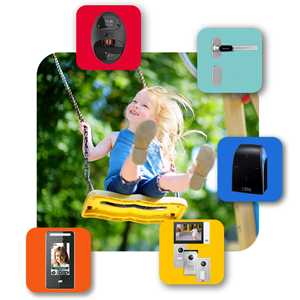
Audio and Video Intercoms: a very basic form of EDAC – in this instance, the response mechanism is a person who verifies the person wanting to gain access is legitimate.
RFID readers: RFID (radio frequency identification) is a form of wireless communication which uses radio waves to identify whether the authentication token held by a user (normally a fob or a card) is valid.
Bluetooth readers: An app on a user’s phone contains the access control credentials for the specific reader, settings can be enabled that the user has to tap their phone within a short range of a reader to prevent accidental activation of access. However, in nursery settings mobile phone usage isn’t permitted, so this would only be suitable for gates or external doors.
Biometric readers such as fingerprint scanners and facial recognition readers: an intrinsic and unique characteristic of the user becomes their ‘key’, it’s uber secure because it can’t be lost, left behind or lent to anyone else.
The above three systems are usually powered by an access control software, this then gives managers the ability to update credentials remotely and run reports on access and access attempts as well as controlling lock down or evacuation procedures from the software.
Electronic door access control systems include various features that can improve security and expedite operations in nurseries. Individuals seeking access are verified using authentication criteria; which could be something the person is carrying (a swipe card or fob, or their mobile phone, or something that the person has, such as biometric characteristics including their face or finger. These systems have reporting and alert capabilities, allowing nursery managers to keep a close check on admissions and exits. Visitor tracking and logging complies with the EYFS framework.
The use of EDAC systems in nurseries has various advantages. For starters, it dramatically improves child safety by preventing unauthorised access. Only authorised personnel are permitted to enter the premises, decreasing the danger of injury to children and workers. In the event of a security breach, EDAC systems quickly notify nursery staff, allowing for a swift reaction to any threat.
There are two broad types of emergency response protocols:
Electronic access control systems generally have software that can be programmed to initiate either a complete unlocking of all external and internal exits, or indeed initiate a lock down. Controlled via an app or with a ‘duress’ enrolled finger for a fingerprint scanner, which initiates the emergency protocol.
These solutions don’t just improve operating safety, they improve efficiency and save your team time. Biometric means of admission have eliminated the need for nursery workers to carry around keys. This not only minimises administrative effort but also simplifies entrance and exit operations, resulting in a more efficient flow of everyday activities.
Parents also benefit from the peace of mind that EDAC systems provide. The system gives real-time information about nursery security, building trust with parents and caregivers.
Case Study: Day Care At Saint Martins, a long standing Almas Customer, stands as a testament to the effectiveness of EDAC systems. Located near Solihull Preparatory School, this great nursery underwent significant refurbishments in August 2020, equipping the premises with modern facilities and four spacious outdoor gardens. They enhanced supervision, provision, and safeguarding, thereby focussing on ensuring the children’s safety.
Electronic door access control systems not only keep staff secure but also play a vital role in lockdown drills. The nursery’s ability to lockdown inside and outside points swiftly during emergencies is sadly something providers now have to prepare for and rehearse.

The Role of Electronic Door Access Control in Nurseries
Electronic door access control systems have become the cornerstone of nursery security for several reasons.
Prioritising the installation of EDAC systems as a nursery owner and leader is not just a legislative requirement, but also a testimonial to your dedication to creating a safe and secure environment for the children in your care.
Lockdown preparedness is now part of safeguarding best practice across education, and early years’ settings are no exception.
Modern Nursery Door Access Control systems can integrate directly with lockdown alarms, providing:
One-Touch Lockdown Activation
A single button can automatically secure entry points across the setting.
Instant Magnetic Door Control
Magnetic locks can secure external access points immediately while maintaining internal safety routes in line with fire regulations.
Remote Locking for Multi-Site Groups
Nursery groups can monitor lockdown procedures remotely, providing central oversight and reassurance.
Controlled Release After Incident
Access can be restored in a structured, logged way, avoiding confusion once a situation is resolved.
Importantly, this can be achieved without compromising the warm, welcoming environment that nurseries must maintain daily.
Electronic systems remain discreet in normal operation, but powerful when needed.
Contact Us For Advice
Our Almas Security Experts will assist you in determining the best system to safeguard your nursery, we’ve been protecting and securing Early Years’ Settings for over 17 years. We know the challenges the sector is facing and have the solutions to protect your team, the children in your care and your business.